
The Short Answer
Seamless gutters win for a New England climate because they have no middle joints to split, separate or leak. Sectional gutters go up piece by piece and are DIY-friendly, but every joint is a future leak point that freeze-thaw cycles work loose over time. For a new installation in Plainville, seamless aluminum is the standard choice; sectional gutters mainly make sense for a small DIY patch or a short run.
How They Differ
Seamless and sectional gutters differ in how they are built. Sectional gutters come in pre-made lengths, commonly ten feet, that are cut and joined on the ground or at the roof edge, with a sealed connector at every joint. Seamless gutters are roll-formed from one length of aluminum coil at the house, so a whole roofline comes out as a single continuous trough, seamed only at the corners and downspout outlets.
That build difference drives everything else. More joints mean more leak points, more sealant to fail, and more places for debris to catch. Fewer joints mean a cleaner run with less to go wrong.
Seamless vs Sectional at a Glance
| Factor | Sectional | Seamless |
|---|---|---|
| Joints | Every ~10 feet | Corners and outlets only |
| Leak points | Many | Few |
| Installation | Piece by piece, DIY-friendly | Formed on site by a pro |
| Upkeep | More — reseal joints | Less |
| Lifespan in freeze-thaw | Shorter | Longer |
| Best for | Small patch, short run | Full installation |
Why Joints Fail in Plainville
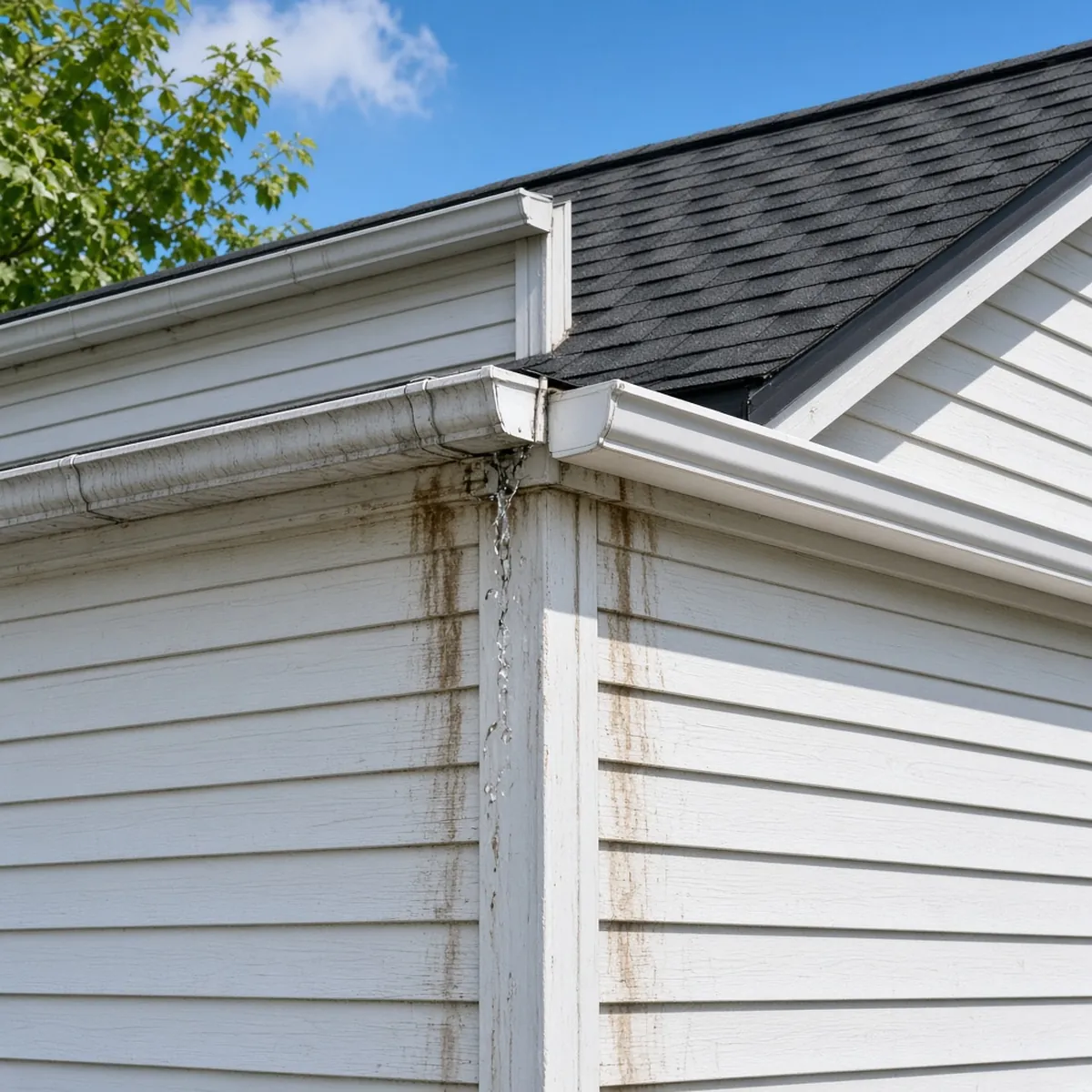
Joints fail in Plainville because the climate works them loose. Every freeze expands the metal and the sealant at a joint, every thaw contracts them, and that cycle repeats through months of winter. Over a few seasons the sealant cracks and the connector separates, and the joint drips. Debris collects at the ridge each joint creates, holding water that freezes and widens the gap further.
A seamless run skips that failure mode for the length of the roofline. The only joints are at the corners and the downspout outlets, where sealed connectors are unavoidable, and those are fewer and easier to maintain than a joint every ten feet. On the town's older homes, swapping leaking sectional gutters for seamless aluminum is the common upgrade.
When Sectional Still Makes Sense
Sectional gutters still make sense in a few cases. A homeowner patching a short run themselves can buy ten-foot sections at a hardware store and join them without a roll-forming machine. A very short or simple roofline, like a small porch, gains little from seamless forming. And a quick temporary fix on one section can use a sectional piece. For a full house, though, the joints become the weak point, which is why seamless is the standard for new installation.
Frequently Asked Questions
Seamless gutters are worth it over sectional for most homes because they remove the middle joints that cause leaks. In Plainville's freeze-thaw winters, sectional joints work loose and drip within a few seasons, so a sectional system needs resealing and repair sooner. Seamless aluminum holds up longer and needs less upkeep, which is why it is the standard choice for a full installation rather than a small patch.
Sectional gutters leak because they are joined every ten feet, and each joint relies on a sealed connector that the climate works loose. Every freeze expands the metal and sealant and every thaw contracts them, so over a few winters the sealant cracks and the joint separates. Debris also collects at each joint, holding water that freezes and widens the gap. More joints simply mean more places for water to escape.
Seamless gutters cannot be installed as a DIY job, because they are roll-formed from aluminum coil by a machine at the house, which homeowners do not own. That on-site forming is what makes a run seamless. Sectional gutters can be bought in pre-cut lengths and joined as a DIY project, but they carry the joint leaks that seamless gutters avoid. A seamless installation is done by a professional with the forming equipment.
Seamless gutters do have a few joints, at the inside and outside corners and at the downspout outlets, where separate pieces must connect. What makes them seamless is the absence of joints along the straight runs — a 40-foot roofline is one continuous piece instead of four joined sections. Far fewer joints means far fewer leak points, which is the whole advantage over a sectional system in a freeze-thaw climate.
Call a Local Gutter Installer in Plainville
For a full house in a freeze-thaw climate, seamless runs outlast sectional gutters. Call 123-456-7890 to reach a local gutter installer, or see the process at gutter installation in Plainville.